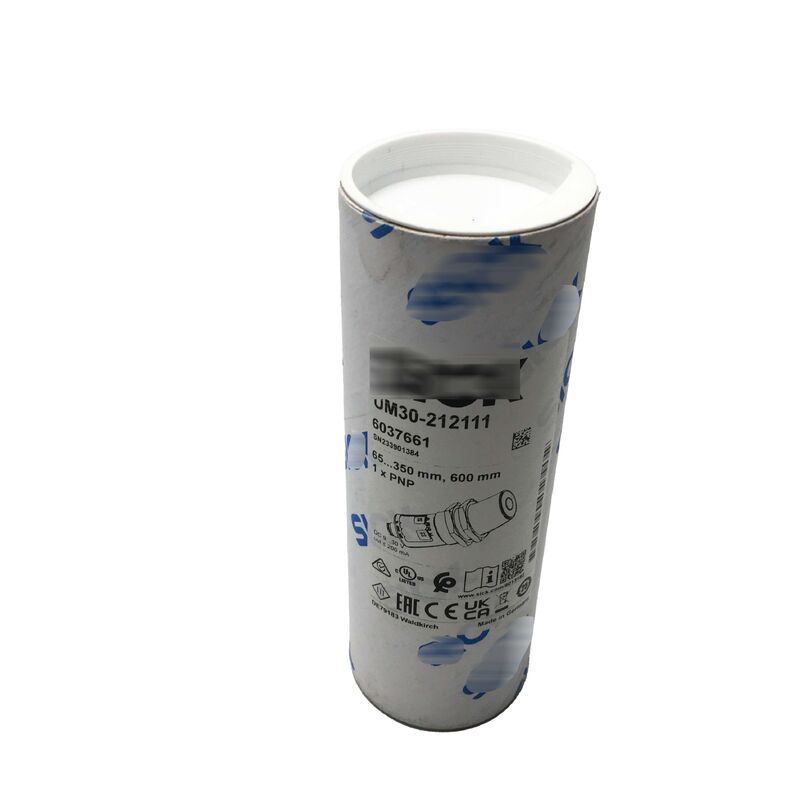
SICK UM30-212111 | Sensor de Distancia Ultrasónico — Rosca M30, 65–350mm, PNP NO/NC, 9–30V CC, 12Hz, Pantalla, IP65/67
Descripción general
El SICK UM30-212111 es un sensor de distancia ultrasónico de gama media de la familia UM30 de SICK, una línea de productos que SICK describe como una solución universal para aplicaciones, y con razón.
El rango de operación de 65–350 mm (con el haz acústico capaz de alcanzar 600 mm en el rango límite), combinado con una salida PNP conmutable, una pantalla LED integrada, operación multimodelo y la capacidad de sincronizar hasta 50 sensores individuales en la misma instalación, lo convierten en una unidad verdaderamente versátil para tareas de detección que desafiarían las tecnologías de proximidad más simples.
La carcasa M30 es un estándar industrial bien establecido para sensores de proximidad.
El montaje en un orificio de instalación estándar de 30 mm posiciona el UM30-212111 en la misma ubicación física que podría haber ocupado anteriormente un sensor inductivo de gran formato, pero el UM30 detecta a distancias y con materiales que un sensor inductivo no puede manejar.
La longitud del cuerpo de 84 mm es compacta para una unidad ultrasónica completa con pantalla y transductor de 400 kHz; el conector macho M12 de 5 pines proporciona las dos líneas de señal necesarias para la salida conmutada y la entrada multifuncional que permite la enseñanza y la sincronización.
La pantalla integrada merece especial atención para un sensor de esta clase. En lugar de requerir un programador externo o software de portátil para configurar el punto de conmutación, el UM30-212111 permite ajustar el umbral directamente en el sensor utilizando los botones de control del panel frontal, con el valor de distancia mostrado en la pantalla en tiempo real.
En la planta de producción, esto significa una puesta en marcha más rápida, ajustes de campo más fáciles cuando cambia la geometría del objetivo y visibilidad directa para la resolución de problemas sin herramientas adicionales.
Especificaciones clave
| Parámetro |
Valor |
| Rango de operación |
65–350mm |
| Rango límite |
600mm |
| Voltaje de suministro |
9–30V CC |
| Salida |
PNP (NO / NC conmutable) |
| Corriente máxima de salida |
≤200mA |
| Frecuencia de conmutación |
12 Hz |
| Tiempo de respuesta |
64ms |
| Resolución |
≥0.18mm |
| Precisión |
±1% (compensado por temperatura) |
| Repetibilidad |
±0.15% |
| Histéresis |
5mm |
| Frecuencia ultrasónica |
400 kHz |
| Rosca |
M30 × 1.5 |
| Dimensiones |
30 × 30 × 84mm |
| Conexión |
M12 macho de 5 pines |
| Entrada MF |
1× |
| Clasificación IP |
IP65 / IP67 |
| Temperatura de operación |
−25°C a +70°C |
| Pantalla |
Integrada, desactivable |
Modos de operación — DtO, Ventana y ObSB
El UM30-212111 admite tres modos de operación que se pueden configurar directamente desde el panel de pantalla. En el modo DtO (Distancia al Objeto), el sensor conmuta cuando el objetivo entra en el punto de conmutación establecido, la función estándar de detección de proximidad.
El modo Ventana define un umbral cercano y lejano; la salida conmuta solo cuando el objetivo está dentro de la ventana de distancia definida, ignorando los objetos fuera de la ventana en cualquier dirección.
El modo ObSB (Objeto entre Sensor y Fondo) enseña primero la distancia del fondo y luego detecta la presencia de cualquier objeto que aparezca entre el sensor y el fondo almacenado, un modo particularmente útil para detectar objetos que se mueven a través de una cinta transportadora donde la superficie de la cinta transportadora en sí no debería activar la salida.
Estos tres modos cubren la gran mayoría de los escenarios de detección industrial.
La capacidad de cambiar entre ellos en el sensor sin reprogramar el PLC o CNC es una ventaja significativa en la puesta en marcha y el mantenimiento.
Sincronización de Múltiples Sensores — Hasta 50 Unidades
El conector M12 de 5 pines incluye un pin de sincronización y multiplexación (pin 5, conductor gris) que conecta varios sensores UM30 entre sí.
En modo sincronizado, todos los sensores conectados emiten simultáneamente, lo que evita que el pulso de sonido de un sensor sea recibido por un sensor adyacente como una detección falsa, un problema común cuando varios sensores ultrasónicos operan en proximidad.
En modo multiplex, los sensores se disparan en secuencia, eliminando por completo la diafonía.
Cualquiera de los modos se escala a 50 sensores, lo que cubre incluso grandes instalaciones de matriz en sistemas de transporte o colectores de medición de nivel multipunto.
Preguntas frecuentes
P1: La hoja de datos muestra 65 mm como rango de operación mínimo, pero la especificación proporcionada indica 60 mm, ¿cuál es correcta?
La hoja de datos oficial de SICK para el UM30-212111 (número de pieza 6037661) especifica 65 mm como el inicio del rango de operación, con el rango nominal completo hasta 350 mm y el rango límite extendiéndose hasta 600 mm.
La cifra de 60 mm citada en algunas listas de productos se redondea hacia abajo y debe tratarse como aproximada. Para aplicaciones donde la detección a 60–65 mm es crítica, pruebe la unidad específica a esa distancia antes de comprometerse con la geometría de instalación.
P2: ¿Cuál es la diferencia entre los modos de salida NO y NC, y cómo se cambia la polaridad de la salida?
En el modo NO (Normalmente Abierto), la salida PNP conmuta a ALTO cuando se detecta un objeto dentro del punto de conmutación.
En el modo NC (Normalmente Cerrado), la salida está en ALTO cuando no se detecta ningún objeto y pasa a BAJO cuando el objetivo está presente, útil para enclavamientos de seguridad de máquinas o lógica de alarma de "objeto faltante" sin requerir inversión de PLC.
El UM30-212111 permite alternar la polaridad de la salida a través del menú de pantalla del panel frontal sin ningún cambio de cableado, lo que permite adaptar el sensor a la lógica requerida del PLC sin volver al armario eléctrico.
P3: ¿Puede el UM30-212111 medir niveles de líquido de forma fiable?
Sí. Los sensores ultrasónicos detectan superficies líquidas de forma fiable porque el sonido se refleja en la superficie independientemente del color o la transparencia del líquido.
El UM30-212111 se utiliza para la monitorización de niveles en tanques, depósitos y recipientes de proceso donde el rango de 65–350 mm cubre la variación de nivel de interés.
Una consideración práctica: la espuma o la turbulencia en la superficie del líquido dispersan la onda sonora y pueden causar lecturas inestables.
El filtro de medición ajustable y la configuración de supresión de primer plano accesibles a través de la pantalla ayudan a estabilizar las lecturas en estas condiciones.
P4: ¿Qué se conecta al pin 5 (conductor gris) y al pin 2 en el M12 de 5 pines?
El pin 5 (gris) es el pin de Sincronización/Multiplexación, utilizado para conectar en cadena varios sensores UM30 para operación sincronizada o multiplexada, o para conectarse a un adaptador SICK Connect+ (pieza 6037782) para visualización y clonación a través de PC.
El pin 2 (blanco) es la entrada multifuncional (MF), utilizada para enseñanza remota, activación de inversión de salida y comandos de configuración del sensor desde el controlador.
Ambos pines no están conectados en una aplicación de conmutación estándar de un solo sensor; la operación PNP estándar de 3 hilos utiliza solo los pines 1 (marrón/alimentación+), 3 (azul/GND) y 4 (negro/salida).
P5: ¿Cómo ayuda la pantalla interna con la puesta en marcha de campo?
Durante la puesta en marcha, la pantalla muestra la distancia medida en vivo en milímetros mientras el sensor escanea.
El técnico mueve el objetivo a la posición de conmutación deseada, presiona el botón de enseñanza y el sensor almacena esa distancia como el umbral de conmutación.
Los dos LED de estado confirman el estado de la salida en tiempo real.
Para el modo ventana, los umbrales cercano y lejano se enseñan individualmente posicionando el objetivo en cada distancia límite y presionando enseñanza para cada umbral. La pantalla se puede desactivar a través del menú para reducir el consumo de energía o evitar interferencias de la luz de la pantalla en entornos sensibles a la luz.


 ¡Su mensaje debe tener entre 20 y 3.000 caracteres!